Monthly Archives: February 2018

Module 07

Module 7 is pulling everything together.  I did not generate a video for this week. As always, you can find readings in Blackboard, with additional resources in Evernote. There are some things you should focus on.

  • Looking at a critical review of ID model. There are two articles you should focus on for this:  (1) Edmonds, G., Branch, R. and Mukherjee, P.  article and (2) Andrews, D. and Goodson, L. article. From these you should think about the types of models and the conceptual framework for evaluating models.
  • The Gibbons & Yanchar article and Molenda, Pershing and Reigeluth chapter focuses on the ID process and what that means about models.
  • Finally, the Nelson, Magliaro and Sherman article provides a look at ID from the perspective of intellectual content. This reading talks about the level of complex thinking involved in the ID process. If you’re looking at Bloom’s Taxonomy, we’re at the top. Especially when it comes to your final project.For those interested in learning more in general about expert vs novice problem solving, there has been a lot of research on this, especially in math and sciences. You can do a lit search on this if you’re interested.
Module 04 & Module 05 Recap

RIOs/RLOs

We started off with a discussion about RIOs and RLOs. We had a long discussion about the structure of RLOs and RIOs and how they may be used within the context of instruction. If you are struggling with this concept, please ask. The threaded discussion for Module 05 is a great place for that.

In-class Exercises -Module 04 and Module 05

This week in class we revisited Module 4 along with Module 5.

We then did two in-class exercises. One focuses just on thinking about using Clarke’s Architectures to plan instruction. The second was a longer exercise that covered Module 4 and Module 5. This exercise has you writing objectives and then planning instruction.

For those who missed class, below is a link to the exercise. You should complete the two exercises and return to me.

YEARS ago I created a 2-pager on objectives for the Motivation Course. While the point there was to focus on the affective domain, the general description applies.

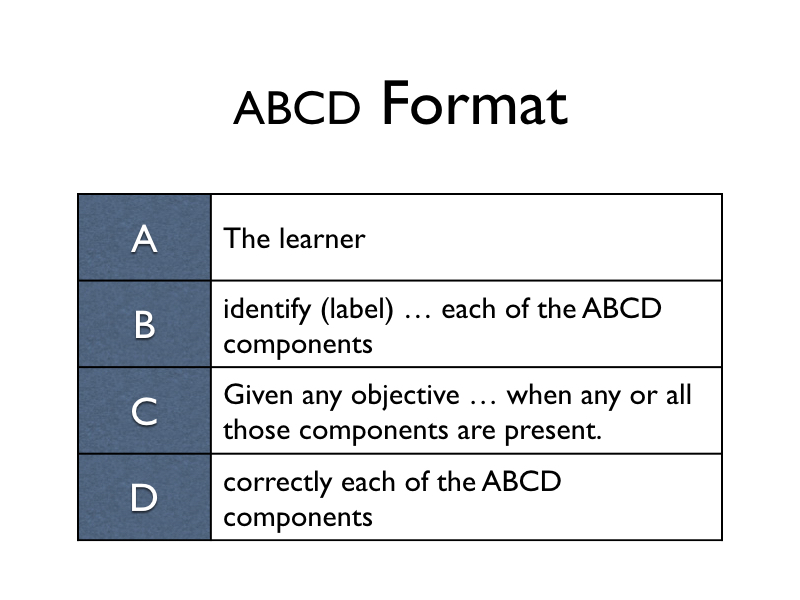
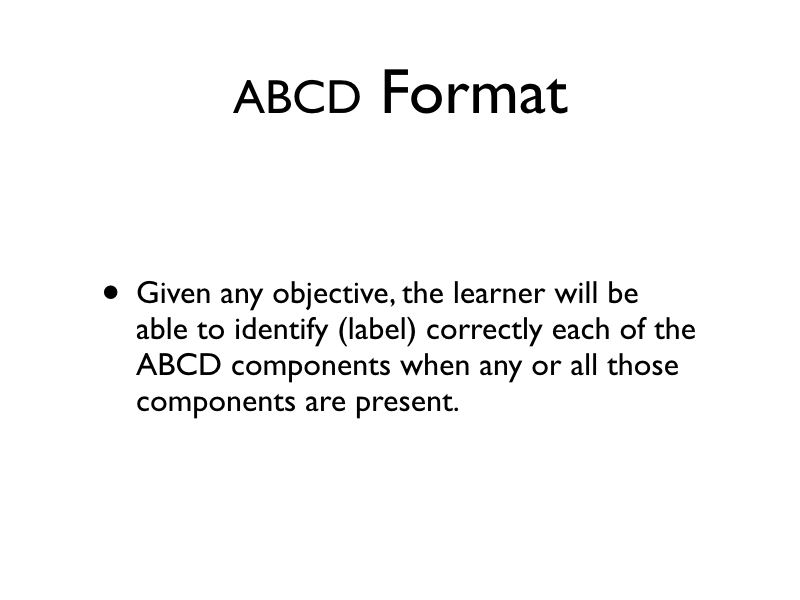
One way to start writing objectives is to start by creating a table and then writing the objective.
Instructional Objectives-writing.001 Instructional Objectives-writing.002

Module 06 – Evaluation

This module is on evaluation. A number of you took the evaluation course, IDE 641, so have learned about designing an evaluation plan in detail. For this module, you should be thinking about evaluation in the context of the ISD process and how evaluation will fit within the context of the Model you are designing for your final project. For the readings, your focus should be on that.

Romi’s chapters give a nice overview of evaluation in the context if ISD. Also, you should make sure you understand the difference between formative and summative evaluation, and how each is incorporated into ISD.

You should make sure you understand the components of Stufflebeam’s CIPP Model for evaluation. This model can help you think about where you will want to include evaluation within the context of your model.

You should also look through the models in the G&B book to see how it is incorporated into various models.

Resources referenced (PDFs) in the intro video:

Module 6 Intro Video

Module 05 – Managing Instruction

There are many ways to organize and manage instruction. The options are differentiated by key concepts, drivers, and ideas on which the program design is based and also by general strategies and specific tactics. In addition, the paradigm for designing and developing instruction influences the instructional model.

Definition of Paradigm: a framework containing the basic assumptions, ways of thinking, and methodology that are commonly accepted by members of a scientific community.

So, for example, constructivism is a paradigm. This module focuses on analyzing and deriving instructional models, and basic processes for creating an instructional model from the perspective of learning architectures.

As you read through this weeks reading, think about your experiences and how these learning architectures have been applied, and how they may apply to your model.

Video 01: Introduction

Video 02:  Merrill’s First Principles

Video 03: Clark’s Learning Architectures (I did not revise this one from last year)

Video 04: RIOs and RLOs

Module 04: The Role of Objectives in ID Planning

Writing Objectives is an important part of the ID process. Too often people will come up with aims or goals but don’t take the time write objectives. Objectives really set up a roadmap for the ID process. Without them the process, and the product, will suffer.

In this Module we will focus on objectives and how to write good objectives. In the Evernote notebook you will find the readings for this Module. There are quite a few there. Keep in mind that major goals of this module are that you understand why objectives are important (Romi Chapters, readings 02-04) and how to write objectives (readings 05-07) at the different levels Blooms Taxonomy (reading 08).

Part 1: Introduction to Objectives

Part 2: Writing Objectives

Module 02 Recap

A quick recap of class session on Tuesday.  As part of class, there was a small group activity. The handout for that is linked in the downloads below.

For those who were unable to attend, you should look at that activity description linked below. Think about how you would go about tackling this example.