Category Archives: recap posts

Module 9 – Recap

This week we talked about teams, what makes an effective team, and working with clients. We did a group activity that looked at Functional Teams.  If you missed class, you should complete this activity. Watch the video and then complete the activity sheet. (send to me via email)

Working With Clients

One of the toughest parts of any project, particularly with a new client, is making sure everyone has the same understanding of the project. As my project team at Project Advance grew, and we took on larger scale projects, we developed a design brief document to help us and the client focus as we began our conversations about a project.

You can find a copy of our design brief template in the Module 9 Evernote Notebook, or here is the direct link to the Note containing that Word Document.

I’ve also put in a copy of the Take Home Exam design brief template..

As I mentioned in class, the take home final will consist of scenario/case of a ID project. You will play the role of the instructional designer who is approached by a client (me) to do a project. Your task will be to complete a design brief. It will be one that has been modified a bit, but it is based on the one we developed at Project Advance.

Module 08 recap

This module looked at technology-based teaching and learning. (Download the slides from class)

For those interested in looking at the Pew Research Foundation findings, see http://www.pewinternet.org For a list of their reports. For some more specific ones:

I find it fascinating is to look at changes over time. (for those in FEA, this would be data you could use when doing environmental scanning.

Each year (since 2011), Fred Cazzava posts on the social media landscape. Each post includes a graphic view. You may be interested in looking at these and how they’ve changed over time, or not, as Fred mentions in 2017.

2011  |  2012 |  2013 |  2014 |  2015 |  2016 | 2017

“2017

In-class Activity

During class we did a small group activity with four groups. Each group had a development context of Technology-based/enhanced learning.

(In-class activity handout)

For each development context, the group had to come up with an ISD model for that development context, then present their model. As part of the planning process, each group could choose a specific context to work through this activity.

Three groups presented, and three are left to present next week. 

Post-class follow-up

Frst, take a moment to reflect on the activity.

Also look back at the googledocA Comparison Of Traditional Modern Instructional DesignDo the additions in the far right column still make sense?

Then for any of the delivery-contexts from the in-class activity, reflect on your thoughts of how this context can make a difference how you may make a difference in your approach to the ID process. You add your thoughts to the googledoc: In Class Activity Reflection

(In-class activity handout)


Module 07 – Recap

This past week was looking at Models, synthesizing the content to date. Dr. Jerry Edmonds came and spoke on Model building. You can download a copy of his slides here:  JerryEdmonds-PresentationSlides.

For those of you who were able to attend class, Dr. Edmonds spoke about model development. One example he gave was the model developed here at SU for program assessment. The early version is on page 11 of the PDF of his slides. The final version is on page 12.  From those two slides you can see there can be a dramatic difference between initial and final models. I was involved with the development of the documentation of the 3-circle model in 2015.

The current version used to explain the model to audiences is found at: http://assessment.syr.edu/assessment/academic-programs/

Module 06 – recap

This week the guest speaker was Dr. Don DeJohn. Don talked about his professional background and how his experience with large data warehouses fits within IDDE: Download a PDF of his slides.

In class we talked about using the CIPP model for planning for evaluation. We did not have time to do the in-class activity, so I posted the handout i the threaded discussion. This is a good module for evaluating training.Kirkpatrick’s model reminds you should consider:

  • Evaluation components .
  • Data collected should depend the component of the CIPP Model.
  • Think about what data can tell you about the worth or merit of a program.


I created to videos. The first is an introduction to the CIPP Evaluation Model, the second is looking at the Baldwin Middle School Case using the CIPP Model.

Module 04 & Module 05 Recap

RIOs/RLOs

We started off with a discussion about RIOs and RLOs. We had a long discussion about the structure of RLOs and RIOs and how they may be used within the context of instruction. If you are struggling with this concept, please ask. The threaded discussion for Module 05 is a great place for that.

In-class Exercises -Module 04 and Module 05

This week in class we revisited Module 4 along with Module 5.

We then did two in-class exercises. One focuses just on thinking about using Clarke’s Architectures to plan instruction. The second was a longer exercise that covered Module 4 and Module 5. This exercise has you writing objectives and then planning instruction.

For those who missed class, below is a link to the exercise. You should complete the two exercises and return to me.

YEARS ago I created a 2-pager on objectives for the Motivation Course. While the point there was to focus on the affective domain, the general description applies.

One way to start writing objectives is to start by creating a table and then writing the objective.
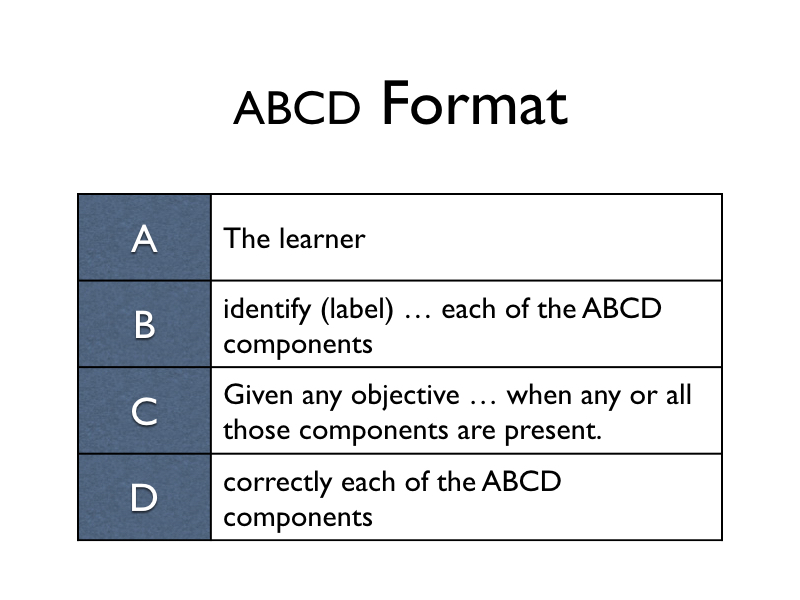
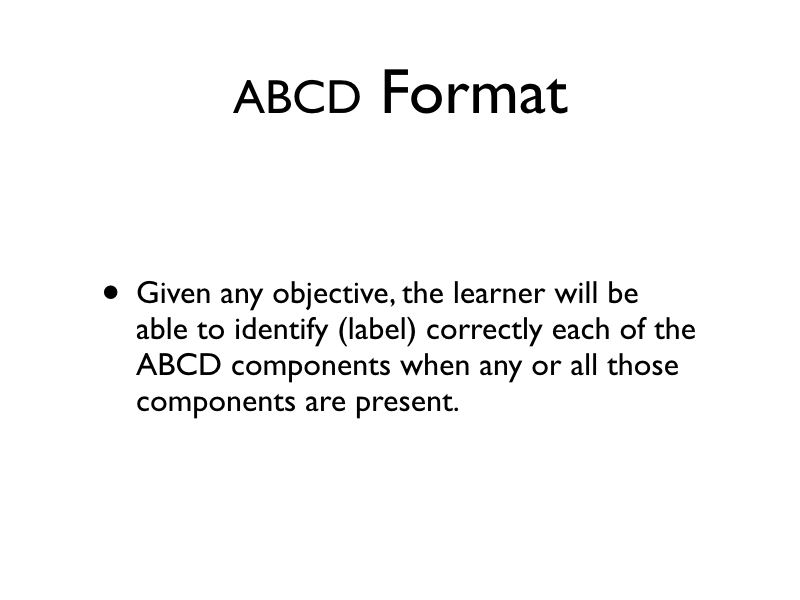
Instructional Objectives-writing.001 Instructional Objectives-writing.002

Module 02 Recap

A quick recap of class session on Tuesday.  As part of class, there was a small group activity. The handout for that is linked in the downloads below.

For those who were unable to attend, you should look at that activity description linked below. Think about how you would go about tackling this example.


Module 01 recap

During this session we viewed a video the 2009 Brown Bag presentation by Alexander Romiszowski.

The brown bag is an example of his presentation style. I had Romi has a professor and this video provides some sense of how he taught.

At the beginning of the video he talks about how he got into the ID field, and his perspectives on ID and what it encompasses. Romi has a wealth of experience doing ID work on many contexts. Being able to hear him speak about his experiences can give us a better understanding the complexity of ‘doing’ instructional design.

You can view his presentation here: (m4v file, plays in iTunes)

You can download the paper of an interview with Romi conducted by Berlin Fang (the english only version).

I also provided two Practical Exercises sheets. If you missed class you should complete the  Practical Exercise sheet I.

  • Practical Exercise I
  • Practical Exercise II:  This is to get you started thinking about your final project. Begin to describe the environment, system, input, process, output, tests, and feedback of your context.

Some other questions to think about are comparing training to education. Here is a sheet you can use to respond to the questions:

  • What is the difference between Education, Training and Instruction? So be able to define each (generality) and provide an example.
  • Why is it important, within the context of doing ID, of understanding this difference?